National Science Olympiad Forum By SOF Olympiad Trainer - Page 687

User Forum

Subject :NSO    Class : Class 7

Ans 1:

Class : Class 7
option c is correct as acceleration means change of speed

Ans 2:

Class : Class 9
Both C and D I prefer. SOF pls check

Ans 3:

Class : Class 9
c and d

Ans 4:

Class : Class 7
agoogle says a

Ans 5:

Class : Class 7
Both 'C' and 'D' are correct

Ans 6:

Class : Class 10
D as it is mentioned that the particle is travelling at a constant speed

Ans 7:

Class : Class 10
not c i think

Ans 8:

Class : Class 9
Both C and D are correct

Ans 9:

Class : Class 7
Both option C and option D are correct as since it is moving in constant speed, it's acceleration will be zero and the direction will not change as it was not mentioned and the particle is travelling on a straight road

Ans 10:

Class : Class 7
option c is correct

Ans 11:

Class : Class 9
both options "C" and "D" are correct in my opinion cause as the car is moving at a constant speed there is no acceleration and as the car is being ridden on a straight road direction of movement also does not change, Hence proving that both option "C" and "D" are correct. I hope my answer was helpful. A very Happy New Year to all

Post Your Answer

Subject :NSO    Class : Class 7

Ans 1:

Class : Class 7
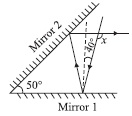
Here the properties of lines and angles will be applied.Then the laws of reflection

Ans 2:

Class : Class 7
Answer is (a). This is observed due to this reasonThere's a line which is making an angle 55° and is a linear pair. Hence the angle of line (mirror) p is 180°. But 55° is not the angle of incidence. To get the sum of angle of incidence and reflection, we multiply 55° by 2 and get 70°. Since angle of incidence =angle of reflection, 70°÷2=35°. The angle of incident ray and the reflected ray of P and Q are same thus the sum of the angle of incidence and angle of reflection would be the same (70°). We know, angle of incidence=angle of reflection, hence 70°÷2=35°. Or A=35°

Ans 3:

Class : Class 9
I actually don't get the logic behind it

Ans 4: (Master Answer)

Class : Class 1
The correct answer is C.

Ans 5:

Class : Class 9
I am not able to understand it

Ans 6:

Class : Class 7
The correct is C

Post Your Answer

Subject :NSO    Class : Class 7

Ans 1:

Class : Class 10
the answer should be B because cocave lens is a diverging lens which will diverge the light to all parts of the room

Ans 2:

Class : Class 9
yes ans c

Ans 3:

Class : Class 7
The correct answer is D.

Ans 4:

Class : Class 8
ans= c

Ans 5:

Class : Class 2
A

Ans 6:

Class : Class 7
The answer is B

Ans 7:

Class : Class 5
Ans c

Ans 8:

Class : Class 8

Ans 9:

Class : Class 7
0hi hi hih h hi hi hi hii

Ans 10:

Class : Class 9

Ans 11:

Class : Class 4
yes according to me also the answer is c but in nso practice papers it is written as d

Post Your Answer

Subject :NSO    Class : Class 4

Ans 1:

Class : Class 4

Ans 2:

Class : Class 4
NONE of these is the correct answer

Ans 3:

Class : Class 7
yes you are right

Ans 4:

Class : Class 9
D is correct

Ans 5:

Class : Class 5
the answer is d

Ans 6:

Class : Class 8
I think B and D is correct.

Ans 7:

Class : Class 4
D is correct

Ans 8:

Class : Class 2

Post Your Answer

Subject :NSO    Class : Class 3

Post Your Answer

Subject :NSO    Class : Class 7

Ans 1:

Class : Class 8

Ans 2:

Class : Class 10
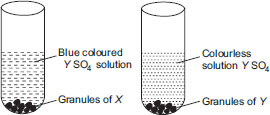
Hcl doesnt react with glass. The explanation is wrong

Ans 3:

Class : Class 6
CCCCCCCCCCCCCCCCCCCCCCCCCCCCCCCCC

Ans 4:

Class : Class 8

Ans 5:

Class : Class 8
hcl reacts with metals too

Ans 6:

Class : Class 10
Hcl doesen't react with metals......Sulphuric acid does

Ans 7:

Class : Class 8
Hydrochloric acid reacts with metals and corrodes them and is therefore stored in glass bottles... This question is wrong and so is the explanation.

Ans 8:

Class : Class 7
Yes, I also agree. HCl is a strong acid and reacts with metals almost exactly like H2S04, it is also stored in glass for this reason, question is wrong.

Ans 9:

Class : Class 9
Hydrocloric acid is very corrosive and reacts with metals . So HCL is stored in glass bottles because it dont causes damage to it . ..........SO 3 statement should be true and their explanation is wrong .

Ans 10:

Class : Class 8
Inorganic acids such as minerals acid like HCL , H2SO4 etc . Are. Not always made in factories . HCL is produced in our stomach.

Ans 11:

Class : Class 5
You all are correct

Ans 12:

Class : Class 10
Hcl reacts with metals also

Ans 13:

Class : Class 8
I completely agree... The HCl reacts with metals , which is major reason of why HCl is stored in glass bottles..

Ans 14:

Class : Class 7
Q is wrong since option 1 is false, rest all are true

Post Your Answer

Subject :NSO    Class : Class 7

Ans 1:

Class : Class 7

Ans 2:

Class : Class 7
i gave the correct answer but in the result they are showing that it is wrong.it is the same case with some other questions too.Please make a note that you correct it,thank you.

Post Your Answer

Subject :NSO    Class : Class 5

Ans 1:

Class : Class 9

Ans 2:

Class : Class 10

Ans 3:

Class : Class 7

Ans 4:

Class : Class 3
D

Ans 5:

Class : Class 7
The answer is D because the stapler is the odd one out

Ans 6:

Class : Class 7
Stapler ( option D ) is the odd one out as it is a third class lever i.e. effort is between the load and fulcrum .

Ans 7:

Class : Class 6
option D is correct because stapler is 3rd class lever

Ans 8:

Class : Class 6
What is type of Option A?

Ans 9:

Class : Class 5

Ans 10:

Class : Class 5
yes because the stapler is a third class lever

Ans 11:

Class : Class 5
Yes option d is correct

Ans 12:

Class : Class 7
according to Google stapler is a third-class lever

Post Your Answer

Subject :NSO    Class : Class 4

Ans 1:

Class : Class 5
I was thinking about body building food

Ans 2:

Class : Class 3

Post Your Answer

Subject :NSO    Class : Class 8

Ans 1:

Class : Class 8
A

Ans 2:

Class : Class 9
The correct answer is B because manure is soluble in water but it is absorbed very slowly

Ans 3:

Class : Class 10
it is A as fertilizers are soluble in water. You might have heard that fertilizers flow into the river and cause eutrophication it flows into river because it is soluble in water

Ans 4: (Master Answer)

Class : Class 1
The correct answer is A.

Ans 5:

Class : Class 8

Ans 6:

Class : Class 8
A

Post Your Answer