Prepare your child for IMO, ISO, IEO, ICSO, IGKO & ISSO with olympiad-level practice.

Prepare your child for IMO, ISO, IEO, ICSO, IGKO & ISSO with olympiad-level practice.

Fill in the blanks using the correct word given in brackets :
(i) All circles are .....(congruent, similar)
(ii) All squares are .....(similar, congruent)
(iii) All .......... triangles are similar (isosceles, equilateral)
(iv) Two polygons of the same number of sides are similar, if (A) their corresponding angles are ....... and (B) their corresponding sides are .....(equal, proportional).
Soln. : (i) All circles are similar.
(ii) All squares are similar.
(iii) All equilateral triangles are similar.
(iv) Two polygons of the same number of sides are similar.
(A) Their corresponding angles are equal and
(B) Their corresponding sides are proportional.
Give two different examples of pair of
(i) similar figures
(ii) non-similar figures
Soln. : (i) (a) Any two circles are similar figures.
(b) Any two squares are similar figures.
(ii) (a) A circle and a triangle are non-similar figures.
(b) An isosceles triangle and a scalene triangle are non-similar figures.
State whether the following quadrilaterals are similar or not :
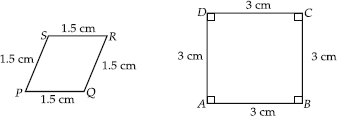
Soln.: On observing the given figures, we find that
Their corresponding sides are proportional but their corresponding angles are not equal.
∴ The given figures are not similar.
In figures (i) and (ii), DE ∥ BC. Find EC in (i) and AD in (ii).
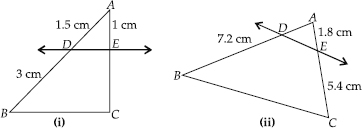
Soln. : (i) Since DE ∥ BC [Given]
∴ Using the Basic proportionality theorem,
We have 
Since, AD = 1.5 cm, DB = 3 cm and AE = 1 cm,
∴ 
By cross-multiplication, we have EC × 1.5 = 1 × 3
⇒ 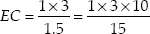
∴ EC = 2 cm
(ii) In ∆ABC, DE ∥ BC
∴ Using the Basic proportionality theorem, we have 
∴ 
⇒ AD × 5.4 = 1.8 × 7.2
⇒ 
∴ AD = 2.4 cm.
E and F are points on the sides PQ and PR respectively of a ∆PQR. For each of the following cases, state whether EF ∥ QR;
(i) PE = 3.9 cm, EQ = 3 cm, PF = 3.6 cm and FR = 2.4 cm
(ii) PE = 4 cm, QE = 4.5 cm, PF = 8 cm and RF = 9 cm
(iii) PQ = 1.28 cm, PR = 2.56 cm, PE = 0.18 cm and PF = 0.36 cm
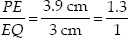
Soln. : (i) We have, PE = 3.9 cm, EQ = 3 cm, PF = 3.6 cm and FR = 2.4 cm
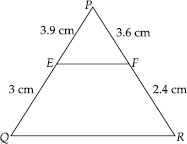
∴ 
And 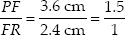
∵ 
∴ 
⇒ EF is not parallel to QR.
(ii) We have, PE = 4 cm, QE = 4.5 cm
PF = 8 cm and RF = 9 cm
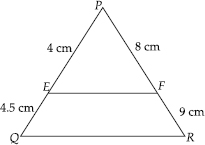
∴ 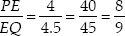
And 
Since, 
⇒ EF is parallel to QR.
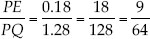
(iii) We have, PE = 0.18 cm, PQ = 1.28 cm
PF = 0.36 cm and PR = 2.56 cm
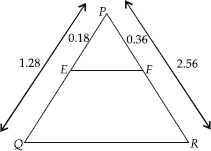
∴ 
And 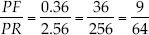
Since, 
⇒ EF is parallel to QR.
In the figure, if LM ∥ CB and LN ∥ CD, prove that 
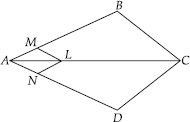
Soln.: In ∆ABC, LM ∥ CB [given]
∴ Using the Basic proportionality theorem, we have
 .....(1)
∵ 
⇒ 
⇒ 
Similarly, in ∆ACD ⇒ LN ∥ CD
∴ Using the Basic proportionality theorem, we have
 .....(2)
From (1) and (2),
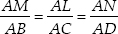
⇒  (Proved)
In the figure, DE ∥ AC and DF ∥ AE. Prove that 
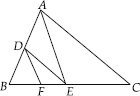
Soln.: In ∆ABC,
∵ DE ∥ AC [given]
∴  .....(1)
[By the basic proportionality theorem]
In ∆ABE,
∴ DF ∥ AE [given]
∴ Using the basic proportionality theorem, we have
 .....(2)
From (1) and (2)
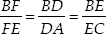
⇒ 
In the figure, DE ∥ OQ and DF ∥ OR. Show that EF ∥ QR.
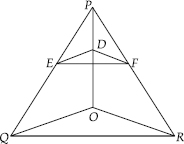
Soln.: In ∆PQO,
∵ DE ∥ OQ [given]
∴ Using the Basic proportionality theorem, we have
 .....(1)
Similarly, in ∆POR, (in which DF ∥ OR) [given]
∴ Using the Basic proportionality theorem, we have
 .....(2)
From (1) and (2),
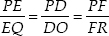
⇒ 
Now, in ∆PQR,
∵ E and F are two distinct points on PQ and PR respectively and  , ie., E and F dividing the two sides PQ and PR in the same ratio in ∆PQR.
∴ By converse of Basic proportionality theorem, EF ∥ QR.
In the figure A, B and C are points on OP, OQ and OR respectively such that AB ∥ PQ and
AC ∥ PR. Show that BC ∥ QR.
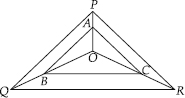
Soln.: In ∆PQR, O is a point and OP, OQ and OR are joined. We have points A, B, and C on OP, OQ and OR respectively such that AB ∥ PQ and AC ∥ PR.
Now, in ∆OPQ,
∵ AB ∥ PQ [Given]
∴  .....(1)
[By the Basic proportionality theorem]
Again, in ∆OPR,
∵ AC ∥ PR [Given]
∴ Using the Basic proportionality theorem, we have
 .....(2)
From (1) and (2),
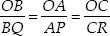
⇒ 
Now, in ∆OQR,
∵ B is a point on OQ, C is a point on OR
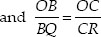 [Proved above]
i.e., B and C divide the sides OQ and OR in the same ratio in ∆OQR.
∴ BC ∥ QR.
Using Basic proportionality theorem, prove that a line drawn through the mid-point of one side of a triangle parallel to another side bisects the third side.
Soln. : We have ∆ABC, in which D is the midpoint of AB and E is a point on AC such that DE ∥ BC.
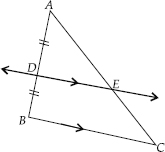
∵ DE ∥ BC [given]
∴ Using the Basic proportionality theorem, we get
 .....(1)
But D is the mid-point of AB
∴ AD = DB
⇒  .....(2)
From (1) and (2),

⇒ EC = AE
⇒ E is the mid point of AC. Hence, it is proved that a line through the midpoint of one side of a triangle parallel to another side bisects the third side.
Using converse of basic proportionality theorem, prove that the line joining the mid-points of any two sides of a triangle is parallel to the third side.
Soln. : We have ∆ABC, in which D and E are the mid-points of sides AB and AC respectively.
∴ AD = DB and AE = EC
From (1) and (2), we have
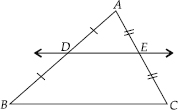
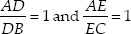
⇒ 
⇒ DE ∥ BC (By converse of Basic proportionality theorem).
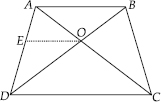
ABCD is a trapezium in which AB ∥ DC and its diagonals intersect each other at the point O. Show that 
Soln. : We have, a trapezium ABCD such that
AB ∥ DC. The diagonals AC and BD intersect each other at O.
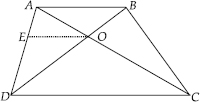
Let us draw OE parallel to either AB or DC.
In ∆ADC
OE ∥ DC [By construction]
∴ Using the Basic proportionality theorem, we get
 .....(1)
In ∆ABD
OE ∥ AB [By construction]
∴ Using the Basic proportionality theorem, we get

⇒  .....(2)
From (1) and (2),
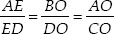
⇒ 
The diagonals of a quadrilateral ABCD intersect each other at the point O such that 
Show that ABCD is a trapezium.
Soln. : It is given that 
From 
(Through O, draw OE ∥ BA)
In ∆ADB
OE ∥ AB [By construction]
∴ Using the Basic proportionality theorem, we get

⇒  .....(1)
Also,  .....(2)
From (1) and (2), we have
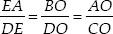
i.e., the points O and E on the sides AC and AD (of ∆ADC) respectively are in the same ratio.
∴ Using the Basic proportionality theorem, we get
OE ∥ DC and OE ∥ AB
⇒ AB ∥ DC
⇒ ABCD is a trapezium.
State which pairs of triangles in the given figures are similar. Write the similarity criterion used by you for answering the question and also write the pairs of similar triangles in the symbolic form.
(i) 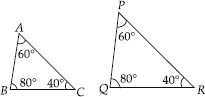
(ii) 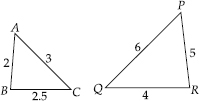
(iii) 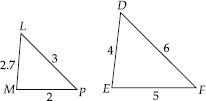
(iv) 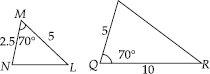
(v) 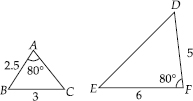
(vi) 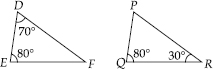
Soln. : (i) In ∆ABC and ∆PQR,
We have : ∠A = ∠P = 60°
∠B = ∠Q = 80°
∠C = ∠R = 40°
∴ The corresponding angles are equal.
∴ Using the AAA similarity rule,
∆ABC ~ ∆PQR
(ii) In ∆ABC and ∆QRP,


i.e., , 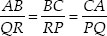
i.e., Using the SSS similarity, ∆ABC ~ ∆QRP
(iii) In ∆LMP and ∆DEF,
∵ 
⇒ 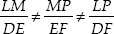
⇒ ∆s are not similar.
(iv) In ∆MNL and ∆QPR,
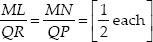 and ∠NML = ∠PQR
∴ Using SAS criteria of similarity, we have
∆MNL ~ ∆QPR.
(v) In ∆ABC and ∆FDE,
∠A = ∠F = 80°
∴  are unknown.
∴ The ∆s cannot said to be similar.
(vi) In ∆DEF and ∆PQR,
∠D = ∠P = 70°
[∵ ∠P = 180° - (80° + 30°) = 180° - 110° = 70°]
∠E = ∠Q = 80°
∠F = ∠R = 30° [( ∠F = 180°]
∴ Using the AAA similarity rule, ∆DFE ~ ∆PRQ.
2. In the figure, ∆ODC ~ ∆OBA, ∠BOC = 125° and ∠CDO = 70°. Find ∠DOC, ∠DCO and ∠OAB.
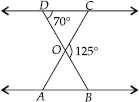
Soln.: We have, ∠BOC = 125° and ∠CDO = 70°
since, ∠DOC + ∠BOC = 180° [Linear pair]
⇒ ∠DOC = 180° - 125° = 55° .....(1)
In ∆DOC,
Using the angle sum property for DODC,
we get
∠DOC + ∠ODC + ∠DCO = 180°
⇒ 55° + 70° + ∠DCO = 180°
⇒ ∠DCO = 180° - 55° - 70° = 55°
Again,
∠DOC = ∠BOA .....(2)
[vertically opposite angles]
and ∠OCD = ∠OAB = 55° .....(3)
(corresponding angles of similar triangles)
Thus, from (1), (2) and (3)
∠DOC = 55°, ∠DCO = 55° and ∠OAB = 55°.
Diagonals AC and BD of a trapezium ABCD with AB ∥ DC intersect each other at the point O. Using a similarity criterion for two triangles, show that 
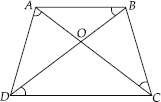
Soln.: We have a trapezium ABCD in which AB ∥ DC. The diagonals AC and BD intersect at O.
In ∆OAB and ∆OCD,
∵ AB ∥ DC and AC and BD intersect each other at point O.
∴ ∠OBA = ∠ODC (Alternate angles)
and ∠OAB = ∠OCD (Alternate angles)
∴ Using AA similarity rule, ∆OAB ~ ∆OCD
So,  (Ratios of corresponding sides of the similar triangles)
⇒ 
In the figure,  and ∠1 = ∠2. Show that ∆PQS ~ ∆TQR.
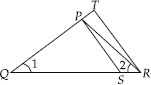
Soln.: In ∆PQR
∵ ∠1 = ∠2 [Given]
∴ PR = QP .....(1)
[( In a ∆, sides opposite to equal angles are equal]
∵  [Given] .....(2)
From (1) and (2),
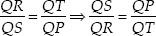 .....(3)
(By taking reciprocals)
Now, in ∆PQS and ∆TQR,
 [From (3)]
and ∠SQP = ∠RQT = ∠1
Now, using SAS similarity rule,
∆PQS ~ ∆TQR.
S and T are points on sides PR and QR of ∆PQR such that ∠P = ∠RTS. Show that
∆RPQ ~ ∆RTS.
Soln. : In ∆PQR,
T is a point on QR and S is a point on PR such that ∠RTS = ∠P.
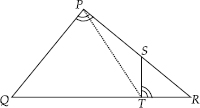
Now in ∆RPQ and ∆RTS,
∠RPQ = ∠RTS [Given]
∠PRQ = ∠TRS [Common]
∴ Using AA similarity, we have ∆RPQ ~ ∆RTS.
In the figure, if ∆ABE ≅ ∆ACD, show that ∆ADE ~ ∆ABC.
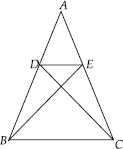
Soln. : We have, ∆ABE ≅ ∆ACD
∴ Their corresponding parts are equal, i.e.,
AB = AC, AE = AD
⇒ 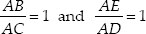
∴ 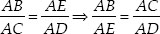
⇒  .....(1) [∵ AE = AD]
Now in ∆ADE and ∆ABC,  [from (1)]
and ∠DAE = ∠BAC (each = ∠A)
∴ Using the SAS similarity, we have
∆ADE ~ ∆ABC.
In the figure, altitudes AD and CE of ∆ABC intersect each other at the point P. Show that:
(i) ∆AEP ~ ∆CDP
(ii) ∆ABD ~ ∆CBE
(iii) ∆AEP ~ ∆ADB
(iv) ∆PDC ~ ∆BEC
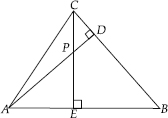
Soln.: We have a ∆ABC in which altitude AD and CE intersect each other at P.
⇒ ∠D = ∠E = 90° .....(1)
(i) In ∆AEP and ∆CDP,
∠AEP = ∠CDP [From (1)]
∠EPA = ∠DPC [Vertically opp. angles]
∴ Using AA similarity, we get ∆AEP ~ ∆CDP
(ii) In ∆ABD and ∆CBE,
∠ADB = ∠CEB [From (1)]
Also, ∠ABD = ∠CBE [Common]
∴ Using AA similarity, we have
∆ABD ~ ∆CBE
(iii) In ∆AEP and ∆ADB,
∵ ∠AEP = ∠ADB [From (1)]
Also, ∠EAP = ∠DAB [Common]
∴ Using AA similarity, we have
∆AEP ~ ∆ADB
(iv) In ∆PDC and ∆BEC,
∵ ∠PDC = ∠BEC [From (1)]
Also, ∠DCP = ∠ECB [Common]
∴ Using AA similarity, we have
∆PDC ~ ∆BEC
E is a point on the side AD produced of a parallelogram ABCD and BE intersects CD at F. Show that ∆ABE ~ ∆CFB.
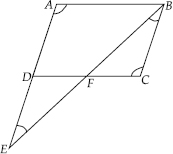
Soln.: We have a parallelogram ABCD in which AD is produced to E and BE is joined such that BE intersect CD at F.
Now, in ∆ABE and ∆CFB
∠BAE = ∠FCB [Opp. angles of a ∥ gm are always equal]
∠AEB = ∠CBF [∵ Parallel sides are intersected by the transversal BE]
Now, using AA similarity, we have ∆ABE ~ ∆CFB.
In the figure, ABC and AMP are two right triangles, right angled at B and M respectively.
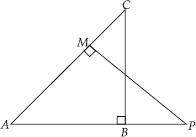
Prove that : (i) ∆ABC ~ ∆AMP
(ii) 
Soln. : We have ∆ABC, right angled at B and ∆AMP, right angled at M.
∴ ∠B = ∠M = 90° .....(1)
(i) In ∆ABC and ∆AMP,
∵ ∠ABC = ∠AMP [From (1)]
and ∠BAC = ∠MAP [Common]
∴ Using AA similarity, we get ∆ABC ~ ∆AMP
(ii) ( ∆ABC ~ ∆AMP [As proved above]
∴ Their corresponding sides are proportional.
⇒ 
CD and GH are respectively the bisectors of ∠ACB and ∠EGF such that D and H lie on sides AB and FE of ∆ABC and ∆EFG respectively. If ∆ABC ~ ∆FEG, show that :
(i) 
(ii) ∆DCB ~ ∆HGE
(iii) ∆DCA ~ ∆HGF
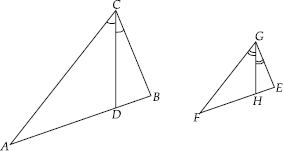
Soln.: We have, two similar ∆ABC and ∆FEG such that CD and GH are the bisectors of ∠ACB and ∠FGE respectively.
(i) In ∆ACD and ∆FGH,
∠A = ∠F [∵ ∆ABC ~ ∆FEG] .....(1)
since ∆ABC ~ ∆FEG
∴ ∠C = ∠G 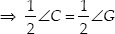
⇒ ∠ACD = ∠FGH .....(2)
From (1) and (2),
∆ACD ~ ∆FGH [AA similarity]
∴ Their corresponding sides are proportional,
∴ 
(ii) In ∆DCB and ∆HGE,
∠B = ∠E [∵ ∆ABC ~ ∆FEG] .....(1)
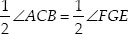
Again, ∆ABC ~ ∆FEG ⇒ ∠ACB = ∠FGE
∴ 
⇒ ∠DCB = ∠HGE .....(2)
From (1) and (2),
∆DCB ~ ∆HGE [AA similarity]
(iii) In ∆DCA and ∆HGF,
∵ ∆ABC ~ ∆FEG ⇒ ∠CAB = ∠GFE
⇒ ∠CAD = ∠GFH ⇒ ∠DAC = ∠HFG .....(1)
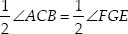
Also, ∆ABC ~ ∆FEG ⇒ ∠ACB = ∠FGE
∴ 
⇒ ∠DCA = ∠HGF .....(2)
From (1) and (2), we have
∆DCA ~ ∆HGF [AA similarity]
In the figure, E is a point on side CB produced of an isosceles triangle ABC with AB = AC. If AD ⊥ BC and EF ⊥ AC, prove that ∆ABD ~ ∆ECF.
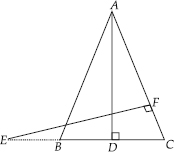
Soln.: We have an isosceles ∆ABC in which AB = AC.
In ∆ABD and ∆ECF,
AB = AC [Given]
⇒ Angles opposite to them are equal
∴ ∠ACB = ∠ABC
⇒ ∠ECF = ∠ABD .....(1)
Again, AD ⊥ BC and EF ⊥ AC
⇒ ∠ADB = ∠EFC = 90° .....(2)
From (1) and (2), we have
∆ABD ~ ∆ECF [AA similarity]
Side AB and BC and median AD of a triangle ABC are respectively proportional to sides PQ and QR and median PM of ∆PQR (see figure). Show that ∆ABC ~ ∆PQR.
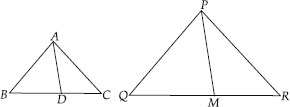
Soln.: We have ∆ABC and ∆PQR in which AD and PM are medians corresponding to sides BC and QR
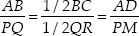
respectively such that 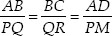
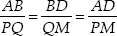
⇒ 
⇒ 
∴ Using SSS similarity, we have
∆ABD ~ ∆PQM
∴ Their corresponding angles are equal.
⇒ ∠ABD = ∠PQM ⇒ ∠ABC = ∠PQR
Now, in ∆ABC and ∆PQR,  .....(1)
Also, ∠ABC = ∠PQR .....(2)
∴ Using SAS similarity from (1) and (2), we get ∆ABC ~ ∆PQR.
D is a point on the side BC of a triangle ABC such that ∠ADC = ∠BAC. Show that CA2 = CB⋅CD.
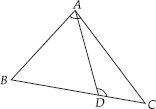
Soln.: We have a ∆ABC and a point D on its side BC such that ∠ADC = ∠BAC.
In ∆BAC and ∆ADC,
∵ ∠BAC = ∠ADC [Given]
and ∠BCA = ∠DCA [Common]
∴ Using AA similarity, we have ∆BAC ~ ∆ADC.
∴ Their corresponding sides are proportional.
⇒ 
⇒ CA × CA = CB × CD
⇒ CA2 = CB × CD
Sides AB and AC and median AD of a triangle ABC are respectively proportional to sides PQ and PR and median PM of another triangle PQR. Show that ∆ABC ~ ∆PQR.
Soln. : Given : ∆ABC and ∆PQR in which AD and PM are medians.
Also, 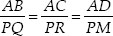 .....(1)
To prove : ∆ABC ~ ∆PQR
Construction : Produce AD to E and PM to N such that AD = DE and PM = MN. Join BE, CE, QN and RN.
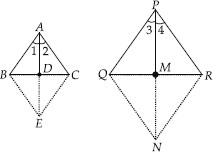
Proof : Quadrilaterals ABEC and PQNR are parallelograms, since their diagonals bisect each other at point D and M respectively.
⇒ BE = AC and QN = PR
⇒ 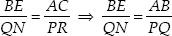
[By (1)]
i.e.,  .....(2)
From (1), 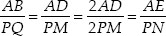
⇒  .....(3)
From (2) and (3), we have
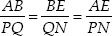
⇒ ∆ABE ~ ∆PQN ⇒ ∠1 = ∠3 .....(4)
Similarly, we can prove
∆ACE ~ ∆PRN ⇒ ∠2 = ∠4 .....(5)
From (4) and (5)
⇒ ∠1 + ∠2 = ∠3 + ∠4
⇒ ∠A = ∠P .....(6)
Now, in ∆ABC and ∆PQR, we have
 [From (1)]
and ∠A = ∠P [From (6)]
∴ ∆ABC ~ ∆PQR (SAS similarity criterion)
A vertical pole of length 6m casts a shadow 4 m long on the ground and at the same time a tower casts a shadow 28 m long. Find the height of the tower.
Soln. : Let AB = 6m be the pole and BC = 4 m be its shadow (in right ∆ABC), whereas DE and EF denote the tower and its shadow respectively.
∵ EF = Length of the shadow of the tower = 28 m
and DE = h = Height of the tower
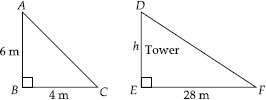
In ∆ABC and ∆DEF, we have ∠B = ∠E = 90°
∠A = ∠D [∵ Angular elevation of the
sun at the same time is equal]
∴ Using AA criteria of similarity, we have
∆ABC ~ ∆DEF
∴ Their sides are proportional i.e.,

⇒ 
Thus, the required height of the tower is 42 m.
16. If AD and PM are medians of triangles ABC and PQR, respectively where, ∆ABC ~ ∆PQR, prove that 
Soln. : We have ∆ABC ~ ∆PQR such that AD and PM are the medians corresponding to the sides BC and QR respectively.
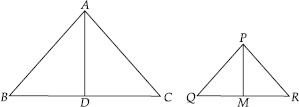
∵ ∆ABC ~ ∆PQR
And the corresponding sides of similar triangles are proportional.
∴ 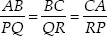 .....(1)
∵ Corresponding angles are also equal in two similar triangles.
∴ ∠A = ∠P, ∠B = ∠Q and ∠C = ∠R .....(2)
Since, AD and PM are medians.
∴ BC = 2BD and QR = 2QM
∴ From (1), 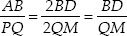 .....(3)
And ∠B = ∠Q ⇒ ∠ABD = ∠PQM .....(4)
∴ From (3) and (4), we have
∆ABD ~ ∆PQM
∴ Their corresponding sides are proportional.
⇒ 
Do you have any Query On Level-2 Content.
Leave your details here, our customer care executive will call you in a short while.
Your Query Has Been Submitted Successfully .Our representative will call you shortly and help you prepare for SOF Olympiad.
