Prepare your child for IMO, ISO, IEO, ICSO, IGKO & ISSO with olympiad-level practice.

Prepare your child for IMO, ISO, IEO, ICSO, IGKO & ISSO with olympiad-level practice.

The graphs of y = p(x) are given in the below figures, for some polynomials p(x ). Find the number of zeroes of p(x), in each case.
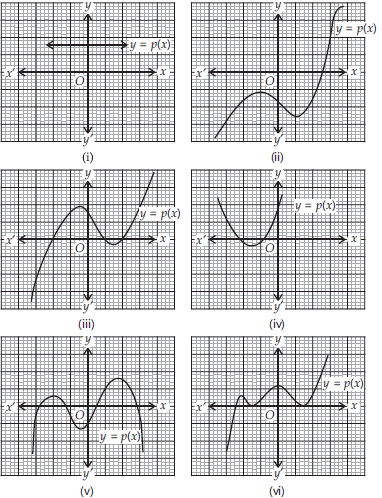
Soln. : (i) The given graph is parallel to x-axis, it does not intersect the x-axis.
∴ It has no zero.
(ii) The given graph intersects the x-axis at one point only.
∴ It has one zero.
(iii) The given graph intersects the x-axis at three points.
∴ It has three zeroes.
(iv) The given graph intersects the x-axis at two points.
∴ It has two zeroes.
(v) The given graph intersects the x-axis at four points.
∴ It has four zeroes.
(vi) The given graph meets the x-axis at three points.
∴ It has three zeroes.
Find the zeroes of the following quadratic polynomials and verify the relationship between the zeroes and the coefficients.
(i) x2 - 2 x - 8
(ii) 4s2 - 4s + 1
(iii) 6x2 - 3 - 7x
(iv) 4u2 + 8u
(v) t2 - 15
(vi) 3x2 - x - 4
Soln. : (i) We have p(x) = x2 - 2x - 8
= x2 + 2x - 4x - 8
= x(x + 2) - 4(x + 2)
= (x - 4)(x + 2)
For p(x) = 0, we have (x - 4)(x + 2) = 0
Either x - 4 = 0 ⇒ x = 4 or x + 2 = 0 ⇒ x = - 2
∴ The zeroes of x2 - 2x - 8 are 4 and - 2
Now, sum of the zeroes = 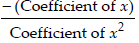

Thus, the relationship between zeroes and the coefficients in x2 - 2x - 8 is verified.
(ii)We have p(s) = 4s2 - 4s + 1
= 4s2 - 2s - 2s + 1
= 2s(2s - 1) - 1(2s - 1)
= (2s - 1)(2s - 1)
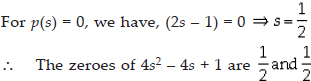
Sum of the zeroes 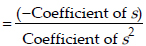
Sum of the zeroes 
Sum of the zeroes 
Sum of the zeroes 
Thus, the relationship between the zeroes and coefficients in the polynomial 4s2 - 4s + 1 is verified.
(iii)We have p(x) = 6x2 - 3 - 7x
= 6x2 - 7x - 3
= 6x2 - 9x + 2x - 3
= 3x(2x - 3) + 1(2x - 3)
= (3x + 1)(2x - 3)
For p(x) = 0, we have,
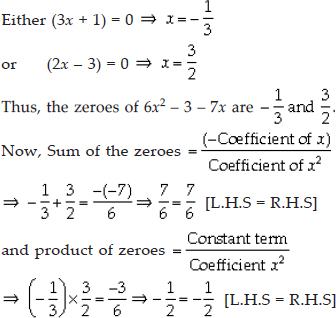
Thus, the relationship between the zeroes and coefficients in the polynomial 6x2 - 3 - 7x is verified.
(iv)We have, f(u) = 4u2 + 8u = 4u(u + 2)
For f(u) = 0,
Either4u = 0 ⇒ u = 0
or u + 2 = 0 ⇒ u = -2
∴ The zeroes of 4u2 + 8u are 0 and - 2.
Now, 4u2 + 8u can be written as 4u2 + 8u + 0.
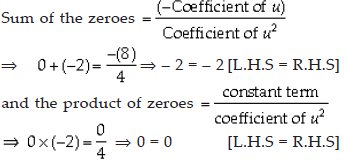
Thus, the relationship between zeroes and the coefficients in the polynomial 4u2 + 8u is verified.
(v) 
For f(t) = 0, we have
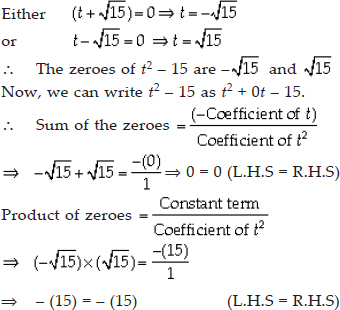
Thus, the relationship between zeroes and the coefficients in the polynomial t2 - 15 is verified.
(vi) We have, f(x) = 3x2 - x - 4
= 3x2 + 3x - 4x - 4
= 3x(x + 1) - 4(x + 1)
= (x + 1)(3x - 4)
For f(x) = 0 ⇒ (x + 1)(3x - 4) = 0
Either(x + 1) = 0 ⇒ x = -1
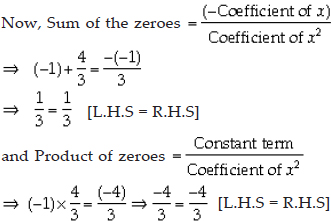
Thus, the relationship between the zeroes and coefficients in 3x2 - x - 4 is verified
Find a quadratic polynomial each with the given numbers as sum and product of its zeroes respectively.
(i) 
(ii) 
(iii) 
(iv) 1, 1
(v) 
(vi) 4, 1
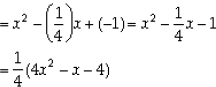
Soln. : (i) Since, sum of the zeroes, 
Product of the zeroes, αβ = - 1
∴ The required quadratic polynomial is
x2 - (α + β)x + αβ
= 
Since, 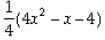 and (4x2 - x - 4) have same zeroes, therefore (4x2 - x - 4) is the required quadratic polynomial.
(ii) Since, sum of the zeroes, 
Product of zeroes, 
∴ The required quadratic polynomial is
x2 - (α + β)x + αβ
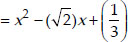
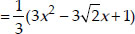
Since, 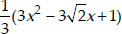 and
 have same zeroes, therefore
 is the required quadratic polynomial.
(iii) Since, sum of zeroes, (α + β) = 0
Product of zeroes, 
∴ The required quadratic polynomial is
x2 - (α + β)x + αβ
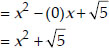
(iv) Since, sum of zeroes, (α + β) = 1
Product of zeroes, αβ = 1
∴ The required quadratic polynomial is
x2 - (α + β)x + αβ
= x2 - (1)x + 1 = x2 - x + 1
(v) Since, sum of the zeroes,  Product of zeroes,

∴ The required quadratic polynomial is
x2 - (α + β)x + αβ
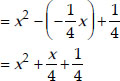
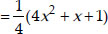
Since,  and
 have same zeroes, therefore, the required quadratic polynomial is

(vi) Since, sum of zeroes, (α + β) = 4 and product of zeroes, αβ = 1
∴ The required quadratic polynomial is
x2 - (α + β)x + αβ = x2 - 4x + 1
Divide the polynomial p(x ) by the polynomial g(x ) and find the quotient and remainder in each of the following :
(i) p(x ) = x3 - 3 x2 + 5 x - 3, g(x ) = x2 - 2
(ii) p(x ) = x4 - 3 x2 + 4 x + 5, g(x ) = x2 + 1 - x
(iii) p(x ) = x4 - 5 x + 6, g(x ) = 2 - x2
Soln. : (i) Here, dividend p(x) = x3 - 3x2 + 5x - 3, divisor g(x) = x2 - 2
∴ We have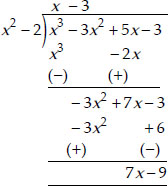
Thus, the quotient = (x - 3)
and remainder = (7x - 9)
(ii) Here, dividend p(x) = x4 - 3x2 + 4x + 5
and divisor g(x) = x2 + 1 - x = x2 - x + 1
∴ We have 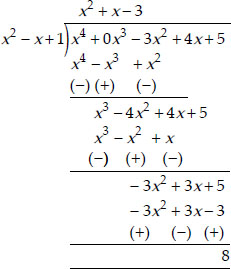
Thus, the quotient is (x2 + x - 3) and remainder = 8
(iii) Here, dividend, p(x) = x4 - 5x + 6 and divisor, g(x) = 2 - x2 = - x2 + 2
∴ We have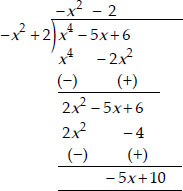
Thus, the quotient = -x2 - 2
and remainder = -5x + 10.
Check whether the first polynomial is a factor of the second polynomial by dividing the second polynomial by the first polynomial :
(i) t2 - 3; 2 t4 + 3 t3 - 2 t2 - 9 t - 12
(ii) x2 + 3 x + 1; 3 x4 + 5 x3 - 7 x2 + 2 x +2
(iii) x3 - 3 x + 1; x5 - 4 x3 + x2 + 3 x + 1
Soln. : (i) Dividing 2t4 + 3t3 - 2t2 - 9t - 12 by t2 - 3, we have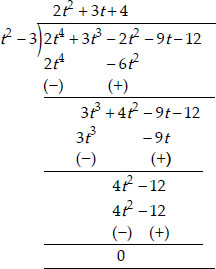
Remainder = 0
∴ (t2 - 3) is a factor of 2t4 + 3t3 - 2t2 - 9t - 12.
(ii) Dividing 3x4 + 5x3 - 7x2 + 2x + 2 by
x2 + 3x + 1, we have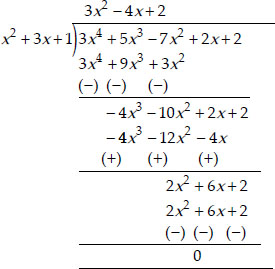
Remainder = 0
∴ x2 + 3x + 1 is a factor of 3x4 + 5x3 - 7x2 + 2x + 2.
(iii) Dividing x5 - 4x3 + x2 + 3x + 1 by
x3 - 3x + 1, we get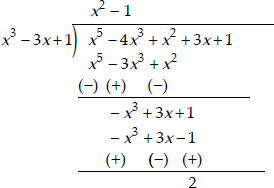
The remainder = 2, i.e., remainder ≠ 0
∴ x3 - 3x + 1 is not a factor of x5 - 4x3 + x2
+ 3x + 1.
Obtain all other zeroes of 3 x4 + 6 x3 - 2 x2 - 10 x - 5, if two of its zeroes are  and -
 .
Soln. : We have p(x) = 3x4 + 6x3 - 2x2 - 10x - 5.
Given  and -
 are zeroes of p(x).
∴ 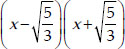 is a factor of p(x).
Now, let us divide 3x4 + 6x3 - 2x2 - 10x - 5 by
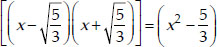 .
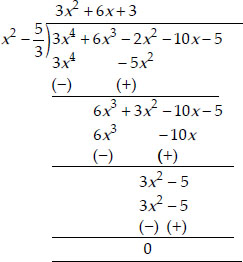
∴ 3x4 + 6x3 - 2x2 - 10x - 5
= (3x2 + 6x +3) (x2 - 5/3)
= 3(x2 + 2x + 1) 
= 3(x + 1)2 (x2 - 5/3)
Thus, the other zeroes of the given polynomial are -1 and -1.
On dividing x3 - 3 x2 + x + 2 by a polynomial g(x ), the quotient and remainder were x - 2 and -2 x + 4 respectively. Find g(x ).
Soln. : Here, Dividend, p(x) = x3 - 3x2 + x + 2
Divisor = g(x),
Quotient = (x - 2) and Remainder = (-2x + 4)
Since, (Quotient × Divisor) + Remainder
= Dividend
∴ [(x - 2) × g(x)] + [(-2x + 4)] = x3 - 3x2 + x + 2
⇒ (x - 2) × g(x) = x3 - 3x2 + x + 2 - (-2x + 4)
= x3 - 3x2 + x + 2 + 2x - 4
= x3 - 3x2 + 3x - 2
∴ g(x) = 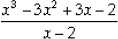
Now, dividing x3 - 3x2 + 3x - 2 by x - 2, we have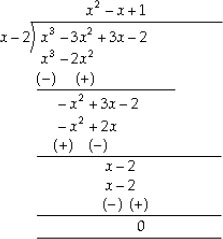
∴ g(x) =  = x2 - x + 1
Thus, the required divisor g(x) = x2 - x + 1.
Give examples of polynomials p(x ), g(x ), q(x ) and r(x ), which satisfy the division algorithm and
(i) deg p(x ) = deg q(x )
(ii) deg q(x ) = deg r(x )
(iii) deg r(x ) = 0
Soln. : (i) p(x) = 3x2 - 6x + 27,
g(x) = 3 and q(x) = x2 - 2x + 9.
Now, deg p(x) = deg q(x)
r(x) = 0
⇒ p(x) = q(x) × g(x) + r(x).
(ii) p(x) = 2x3 - 2x2 + 2x + 3,
g(x) = 2x2 - 1, q(x) = x - 1 and
r(x) = 3x + 2, deg q(x) = deg r(x)
⇒ p(x) = q(x) × g(x) + r(x)
(iii) p(x) = 2x3 - 4x2 + x + 4,
g(x) = 2x2 + 1, q(x) = x - 2 and
r(x) = 6, deg r(x) = 0
⇒ p(x) = q(x) × g(x) + r(x)
Verify that the numbers given alongside of the cubic polynomials below are their zeroes. Also verify the relationship between the zeroes and the coefficients in each case :
(i) 2 x3 + x2 - 5 x + 2;  , 1, - 2
(ii) x3 - 4 x2 + 5 x - 2; 2, 1, 1
Soln. : ∴ (i) p(x) = 2x3 + x2 - 5x + 2


⇒  is a zero of p(x).
Again, p(1) = 2(1)3 + (1)2 - 5(1) + 2
= 2 + 1 - 5 + 2 = 0
⇒ 1 is a zero of p(x).
Also, p(-2) = 2(-2)3 + (-2)2 - 5(-2) + 2
= -16 + 4 + 10 + 2
= -16 + 16 = 0
⇒ - 2 is a zero of p(x).
Now, p(x) = 2x3 + x2 - 5x + 2
∴ Comparing it with ax3 + bx2 + cx + d, we have a = 2, b = 1, c = - 5 and d = 2
Also , 1 and - 2 are the zeroes of p(x).



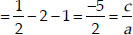
and product of zeroes = αβγ
Thus, the relationship between the coefficients and the zeroes of p(x) is verified.
(ii) Here, p(x) = x3 - 4x2 + 5x - 2
∴ p(2) = (2)3 - 4(2)2 + 5(2) - 2
= 8 - 16 + 10 - 2 = 18 - 18 = 0
⇒ 2 is a zero of p(x)
Again p(1) = (1)3 - 4(1)2 + 5(1) - 2
= 1 - 4 + 5 - 2 = 6 - 6 = 0
⇒ 1 is a zero of p(x).
Now, Comparing p(x) = x3 - 4x2 + 5x - 2 with ax3 + bx2 + cx + d = 0, we have
a = 1, b = - 4, c = 5 and d = - 2
2, 1 and 1 are the zeroes of p(x).
∴ Let α = 2, β = 1, γ = 1
Now, sum of zeroes = α + β + γ
= 2 + 1 + 1 = 4 = -b/a
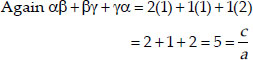
Product of zeroes = αβγ = (2)(1)(1) = 2 = -d/a
Thus, the relationship between the zeroes and the coefficients of p(x) is verifed.
Find a cubic polynomial with the sum, sum of products of its zeroes taken two at a time and the product of its zeroes as 2, -7, -14 respectively.
Soln. : Let the required cubic polynomial be ax3 + bx2 + cx + d and its zeroes be α, β and γ.



If a = 1, then 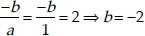
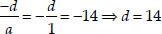
and 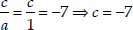
∴ The required cubic polynomial is
1x3 + (-2)x2 + (-7)x + 14
= x3 - 2x2 - 7x + 14.
If the zeroes of the polynomial x3 - 3 x2 + x + 1 are a - b , a , a + b , find a and b .
Soln. : We have p(x) = x3 - 3x2 + x + 1.
Comparing it with Ax3 + Bx2 + Cx + D,
We have A = 1, B = -3, C = 1 and D = 1
It is given that (a - b), a and (a + b) are the zeroes of the polynomial.
∴ Let α = (a - b), β = a and γ = (a + b)

⇒ (a - b) + a + (a + b) = 3
⇒ 3a = 3
⇒ a = 1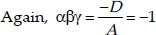
⇒ (a - b) × a × (a + b) = -1
⇒ (1 - b) × 1 × (1 + b) = -1
⇒ 1 - b2 = -1
⇒ b2 = 1 + 1 = 2
Thus, a = 1 and 
If two zeroes of the polynomial
x4 - 6 x3 - 26 x2 + 138 x - 35 are  find other zeroes.
Soln. : Here, p(x) = x4 - 6x3 - 26x2 + 138x - 35
∵ Two of the zeroes of p(x) are : 



= (x2 + 4 - 4x) - 3 = x2 - 4x + 1
or x2 - 4x + 1 is a factor of p(x).
Now, dividing p(x) by x2 - 4x + 1, we have
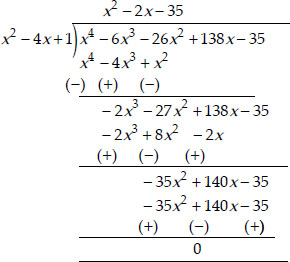
∴ (x2 - 4x + 1)(x2 - 2x - 35) = p(x)
⇒ (x2 - 4x + 1)(x - 7)(x + 5) = p(x)
i.e., (x - 7) and (x + 5) are other factors of p(x).
∴ 7 and - 5 are other zeroes of the given polynomial.
If the polynomial x4 - 6 x3 + 16 x2 - 25 x + 10 is divided by another polynomial x2 - 2 x + k , the remainder comes out to be ( x + a ), find k and a .
Soln. : Applying the division algorithm to the polynomials x4 - 6x3 + 16x2 - 25x + 10 and x2 - 2x + k, we have
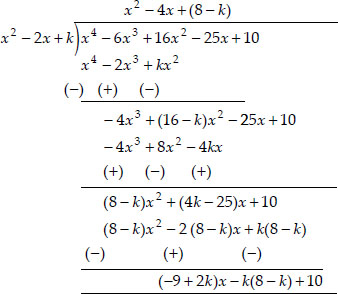
∴ Remainder = (2k - 9)x - k(8 - k) + 10
But the remainder = x + a
Therefore, comparing them, we have
2k - 9 = 1 ⇒ 2k = 1 + 9 = 10
⇒ 
and a = - k(8 - k) + 10
= - 5(3) + 10 = - 15 + 10 = - 5
Thus, k = 5 and a = - 5
Do you have any Query On Level-2 Content.
Leave your details here, our customer care executive will call you in a short while.
Your Query Has Been Submitted Successfully .Our representative will call you shortly and help you prepare for SOF Olympiad.
