Prepare your child for IMO, ISO, IEO, ICSO, IGKO & ISSO with olympiad-level practice.

Prepare your child for IMO, ISO, IEO, ICSO, IGKO & ISSO with olympiad-level practice.

The elders in Goa are nostalgic about the good old
Portuguese days and their love of bread and loaves. The writer says that the eaters of loaves have left but the makers still exist.
Yes, bread making is still popular in Goa. This is very clear from the narrator’s statement that the eaters have gone away leaving the makers behind. There are mixers, moulders and the ones who bake the loaves. The time tested furnaces still exist there.
The baker is called a pader in Goa.
The baker would come twice a day—once early in the morning and the second time when he returned after selling his stuff.
The children would run to meet him as they wanted to have bread-bangles.
Any person who is wearing a half pant which reaches just below the knees invites this comment. This is because the baker, known as a pader, used to dress like that.
Monthly accounts of the baker were recorded on some wall in the house with a pencil.
It means having a plump physique, like a jackfruit.
Yes, bread is an important part of Goan life. It is needed for marriage gifts, parties and feasts. Bread is also needed by a mother for preparing sandwiches during her daughter’s engagement. Thus, it is necessary to have breads for every occasion, because of which the presence of a baker’s furnace in the vi .age is very important
| Clues | Author’s childhood days |
|---|---|
| the way bread was baked | The bakers used to bake loaves in the mixers and moulders, with age-old, time-tested furnaces that were never extinguished |
| the way the pader sold bread | The baker made his musical entry on the scene with the ‘jhang, jhang’ sound of his specially made bamboo staff. One hand supported the basket on his head and the other banged the bamboo on the ground |
| what the pader wore | The baker or bread-seller of those days had a peculiar dress known as the kabai. It was a single-piece long frock reaching down to the knees. In his childhood, he saw bakers wearing shirt and trousers which were shorter than full length ones and longer than half pants. |
| when the pader was paid | The baker usually collected his bills at the end of the month. Monthly accounts used to be recorded on some wall in pencil. |
| how the pader looked | The baker used to have a plump physique with a jackfruit-like physical appearance. |
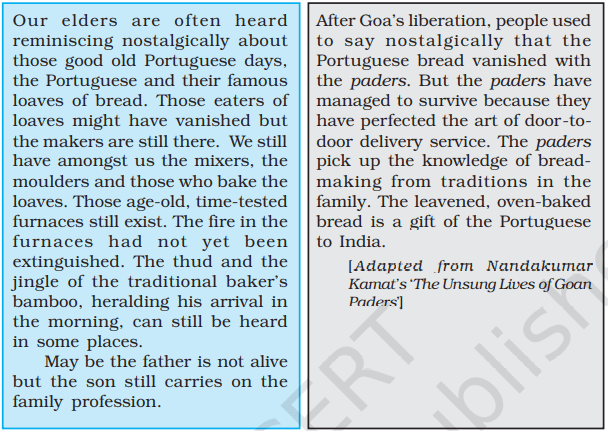
The topic of both the given texts are very similar. They both talk about the paders in Goa. The patterns of describing it though, are different and also based at different times. The text on the left side talks about the memories of the elders who recall nostalgically about those good old Portuguese days, whereas the text on the right-side talks about the period after Goa’s liberation.
Answer: to be self attempted
Do you have any Query On Level-2 Content.
Leave your details here, our customer care executive will call you in a short while.
Your Query Has Been Submitted Successfully .Our representative will call you shortly and help you prepare for SOF Olympiad.
