A story for every Olympiad student who has ever stared at the Reasoning section and gone blank.
Aryan loved Maths. Numbers were his friends. So when his teacher announced the IMO was three months away, he wasn’t nervous — until he opened the sample paper.
Section A. Logical Reasoning. 15 questions. He stared at a number series that followed no rule he’d ever studied. A boy standing south-east of a tree. A code where A became D. He shut the paper. “I’ll just skip this section,” he muttered.
His cousin Priya — an IMO Level 2 qualifier — happened to visit that weekend. She found him sulking.
“It’s Not One Topic. It’s Twelve.”
“Logical Reasoning isn’t one scary thing,” Priya said, pulling up a chair. “It’s twelve different worlds. And each one has a simple trick once you see it.” She picked up a pen.
🔢 Series & Number Patterns
“Don’t stare at the numbers — look at the gaps between them. That’s where the pattern hides.” Aryan tried it. 2, 6, 12, 20… gaps of 4, 6, 8, 10. The answer was 30. “Oh,” he said quietly.
🔄 Analogy & Classification
“Find the relationship in the first pair. Apply it to the second. For Classification, find the one that doesn’t belong — and ask yourself why.”
🔐 Coding & Decoding
“Think of yourself as a spy. Crack the rule once — every letter shifted, swapped, or mirrored — then use it for the whole question.” “That one sounds fun,” Aryan admitted.
👨👩👦 Blood Relations
“NEVER do this in your head. Draw a family tree, even a rough one. One wrong assumption in your mind and the whole answer flips.” Aryan realised this was exactly his mistake.
🧭 Direction Sense Test
“Same rule — draw it. North at the top, always. Every turn goes on paper. Students who skip drawing almost always end up facing the wrong direction. Literally.”
○ Logical Venn Diagrams
“Which diagram best shows the relationship between Dogs, Animals, and Cats? Draw the circles. It’s real-world logic — not abstract rules.”
🔍 Mirror & Water Images
“Mirror: left and right flip. Water: top and bottom flip. Simple — but students mix them under pressure every time.” “I’ve done that,” Aryan confessed. “Everyone does, once.”
🧩 Embedded Figures & Figure Formation
“A small shape is hiding inside a complex figure. Train your eye to trace its outline through the clutter. This one gets easier the more figures you see.”
📐 Paper Folding & Paper Cutting
“Go fold actual paper. Cut a hole. Unfold it. Your hands will teach your brain what no explanation can.” Aryan immediately reached for a sheet from his notebook.
🎲 Cubes & Dice
“Pick up a die. 1 is opposite 6, 2 opposite 5, 3 opposite 4. Always. The student who has held a dice will always answer faster than the one who hasn’t.”
➕ Mathematical Operations & Alpha-Numeric Puzzles
“The rules of Maths are swapped. ‘+’ might mean multiply. Decode the new rule first — then solve. Rush here and you’ll get it wrong every time.” “That’s sneaky,” Aryan said, half-impressed.
🧑🤝🧑 Ranking & Arrangement Tests
“Place the ones you’re sure about first. Let the rest fall into position. Never try to place everyone at once.”
Priya put her pen down. “Still think Logical Reasoning is impossible?”
Aryan was quiet. Then: “No. I just never realised it was twelve different things — and none of them need me to memorise anything. They just need me to think carefully.”
“That,” said Priya, “is exactly the point.”
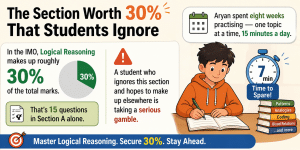
The Section Worth 30% That Students Ignore
In the IMO, Logical Reasoning makes up roughly 30% of the total marks. That’s 15 questions in Section A alone. A student who ignores this section and hopes to make up elsewhere is taking a serious gamble.
Aryan spent eight weeks practising — one topic at a time, 15 minutes a day. On exam day, he finished Section A with seven minutes to spare.
Start Your Child’s Journey at SOF Olympiad Trainer
Our dedicated Logical Reasoning Online Classes and Reasoning Skill Development Package covers all 12 types with chapter-wise practice, 24 interactive tests, and instant feedback — all aligned to the SOF Olympiad syllabus for Class 1 to 10.
Don’t let your child walk in surprised. Let them walk in ready.












All learn
I MO