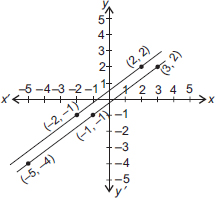
The equations representing the given graph is ____. A 7x + 2y = 11; y – 2x = 3 B 2x + 7y = 11; 5x + (35y/2) = 25 C 3x –7y = 10; 8y – 6x = 4 D 3x –4y = 1; 8y – 6x = 4
A boy multiplied 987 by a certain number and obtained 559981 as his answer. If in the answer both 9s are wrong and the other digits are correct, then the correct answer would be ________. A 553681 B 555181 C 555681 D 556581
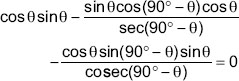
Which of the following is true? (A) (B) If A and B are complementary angles, then A Only (A) B Only (B) C Neither (A) nor (B) D Both (A) and (B)
State 'T' for true and 'F' for false and select the CORRECT option. I. If a quadratic polynomial f(x) is a square of a linear polynomial, then its two zeroes are coincident. II. If a quadratic polynomial f(x) is not factorisable into linear factors, then it has no real zero. III. If graph of quadratic polynomial ax2 + bx + c cuts positive direction of y-axis, then the sign of c is positive. IV. If fourth degree polynomial is divided by a quadratic polynomial, then the degree of the remainder is 2.
Find the missing number. A 5 B 6 C 8 D 12
Which of the following is/are correct? A Product of two irrational numbers is always an irrational number. B The sum of two irrational numbers is always an irrational number. C Sum of rational and irrational number is always an irrational number. D None of these
Which of the following graphs represent the lines 2x + 4y = 8 and 3x – 4y = 12? A B C D
Select the figure from the options in which Fig.(X) is exactly embedded as one of its part. A B C D